
The History of the OG-107 Fatigue Shirt
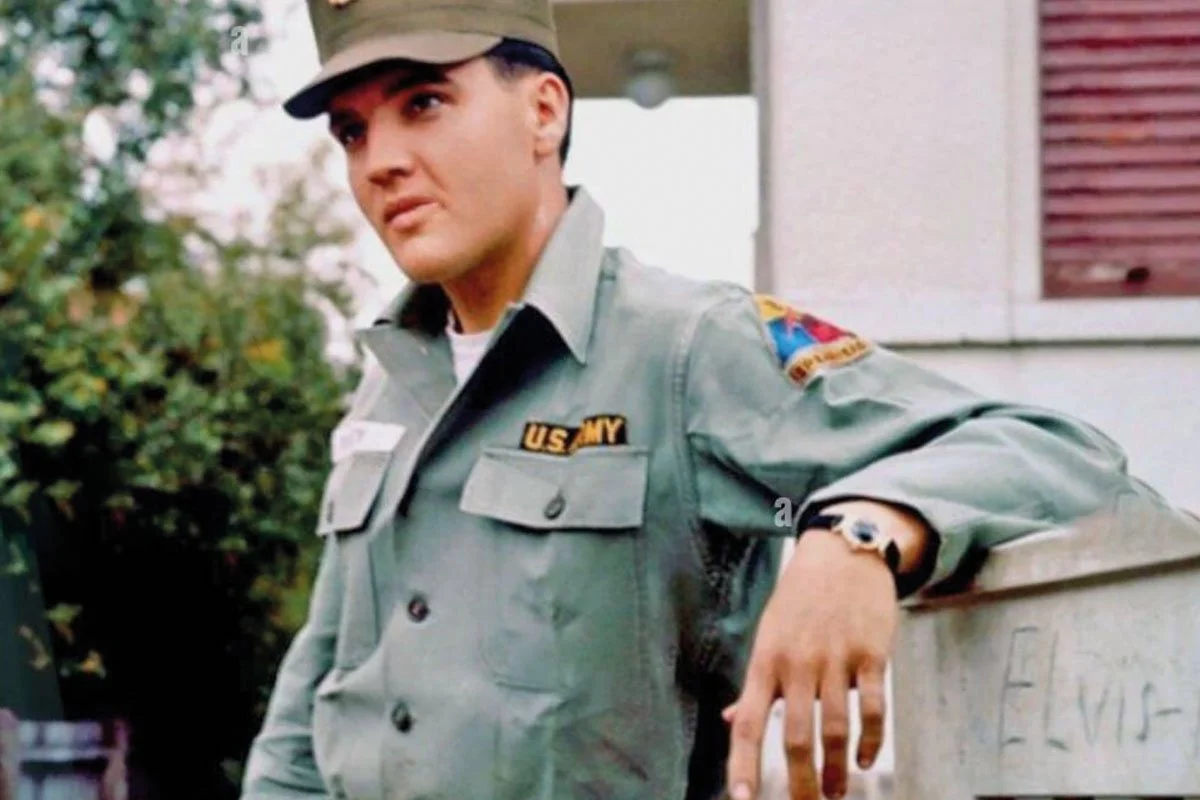
Elvis Presley wearing a Type I Fatigue Shirt during his military service.
I already explored part of the history of the OG-107 uniform with the fatigue pants, so now I want to focus on the other half of the uniform: the shirt.
The name OG-107 comes from the U.S. Army colour designation Olive Green 107. It originally referred to the colour rather than the shirt itself, but the designation eventually became closely associated with the entire cotton-sateen utility uniform. The Army officially called it a utility uniform, but soldiers continued to call it fatigues.
The uniform was introduced in 1952 as the U.S. Army began replacing the herringbone twill utility uniform used during the Second World War. The new uniform consisted of matching trousers and a shirt-like jacket, both made from 8.5 oz cotton sateen, chosen to provide a combination of durability, relatively light weight and comfort.
The shirt was deliberately uncomplicated: a button front, two upper chest patch pockets with buttoned flaps and long sleeves. It was designed as practical utility clothing for soldiers rather than as a specialised combat jacket. It was usually worn with the matching fatigue trousers, which were intended to be bloused into the tops of the boots. In hot and humid conditions, soldiers could roll up their sleeves and unblouse the trousers.
Although the design looks almost too simple today, that simplicity was part of the point. There was very little to get in the way: no unnecessary hardware, no complicated pocket system and no attempt to make the uniform look anything other than practical work clothing. Soldiers also modified their fatigues to suit their own needs. In hotter conditions, shirts were sometimes cut down into short sleeves, while locally made alterations could include extra pockets or other small changes.
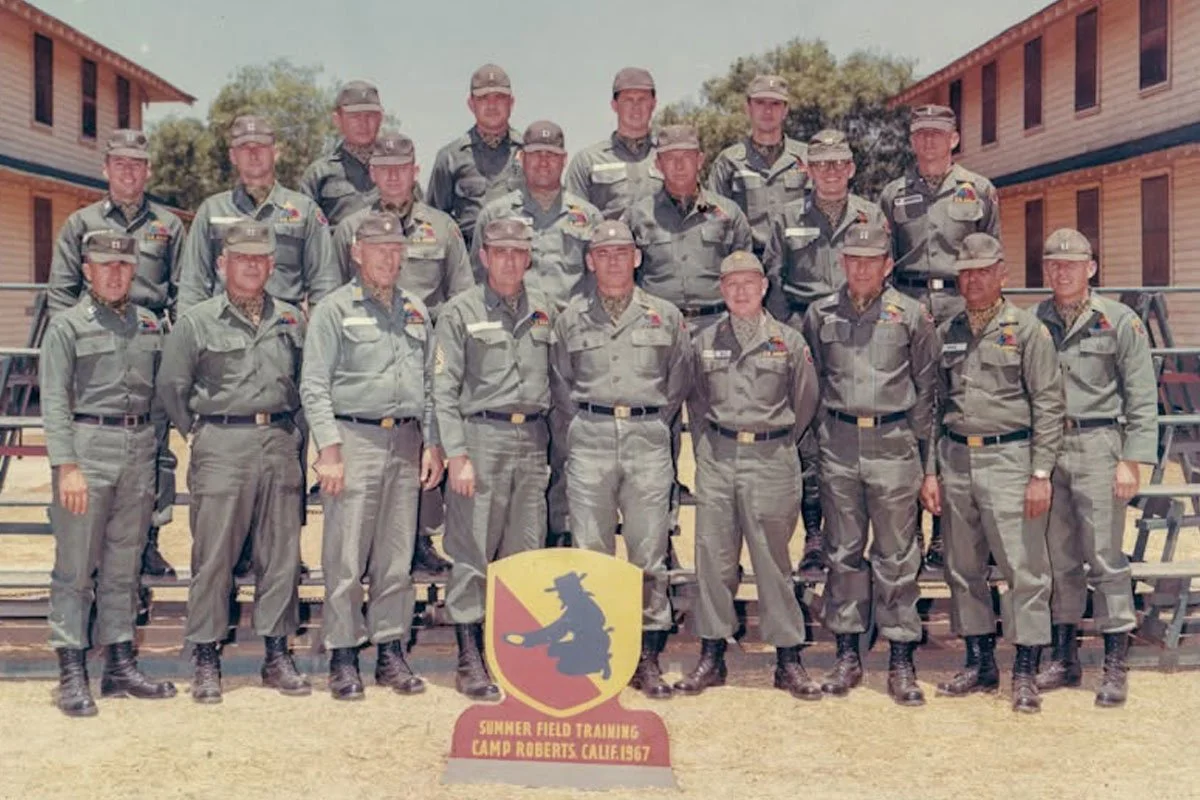
Officers of the 3rd Battalion, 149th Armor Regiment during their 1967 Annual Training, wearing full OG-107 uniforms. Photo from the 149th Armor Regimental Collection, via the California Military Department State Military History & Museums Program.
The OG-107 uniform went on to become the longest-serving U.S. Army uniform, remaining in use from 1952 until 1989. During its long service life, the OG-107 fatigue shirt also went through several changes. There are three main designs, generally referred to as Type I, Type II and Type III. While they share the same basic construction, there are some noticeable differences between them, particularly in the pocket flaps, sleeves, cuffs and buttons.
Type I: 1952-1963
The first version is now generally referred to as the Type I. This is the classic early OG-107 shirt with a fairly boxy, jacket-like body, two rectangular chest pockets, straight sleeves and no buttons on the cuffs. The pocket flaps were rectangular and secured with the characteristic dished buttons. Earlier shirts often had brown buttons, while later examples used darker green ones.
The shirt and trousers were also sized using alphabetical sizes such as Small, Medium and Large, instead of the more precise chest and waist measurements that came later.
The shirts were commonly starched and pressed, particularly when worn on military bases. This might seem strange for what was essentially workwear, but keeping fatigues clean and sharply pressed was part of everyday military life. Soldiers could also go through several sets because of the constant cycle of wearing, washing, starching and pressing them.
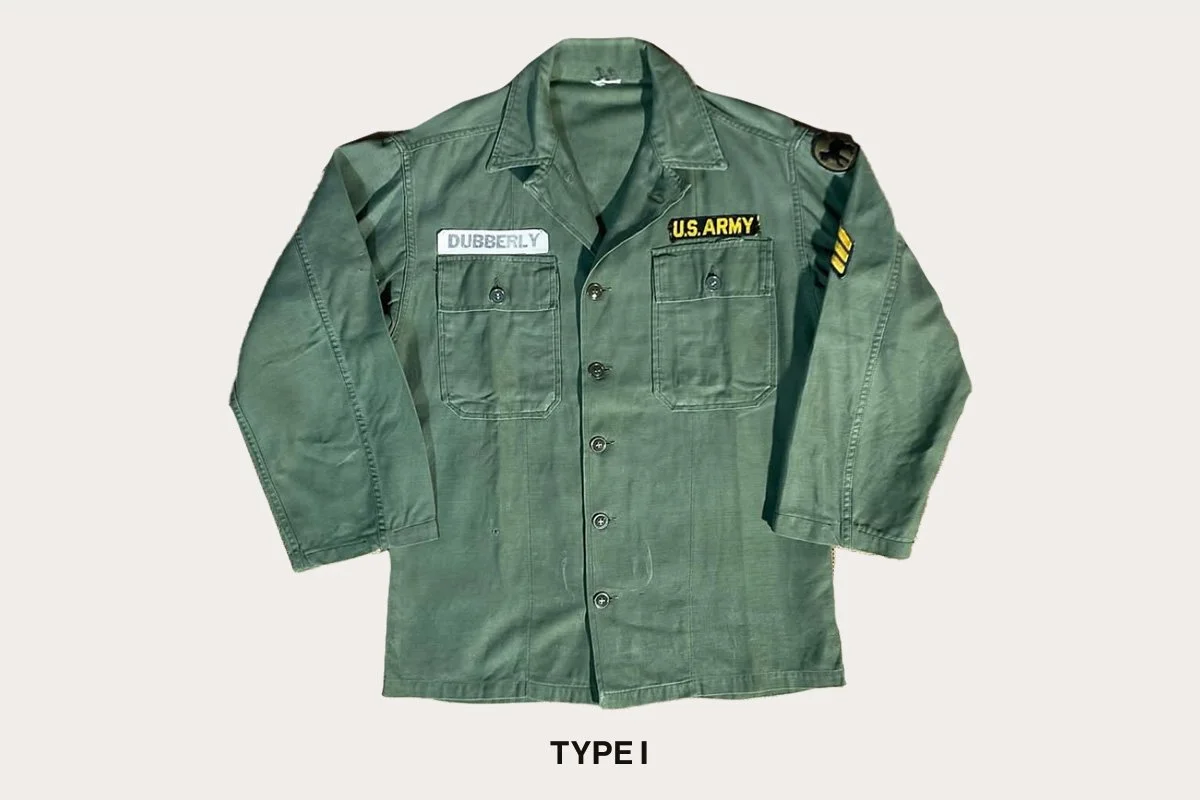
Fatigue Shirt Type I: 1952-1963
Type II: 1963-1964
The Type II was a short-lived transition.
In 1963, the Army changed the utility shirt, most noticeably by altering the shape of the chest-pocket flaps. Instead of being completely rectangular, the corners were clipped, creating the distinctive chamfered shape.
The change may look minor today, but it makes Type II shirts relatively easy to identify. More importantly, the Type II existed for only a short period before another revision arrived in 1964. That makes original Type II shirts considerably less common than the Type I and Type III versions.
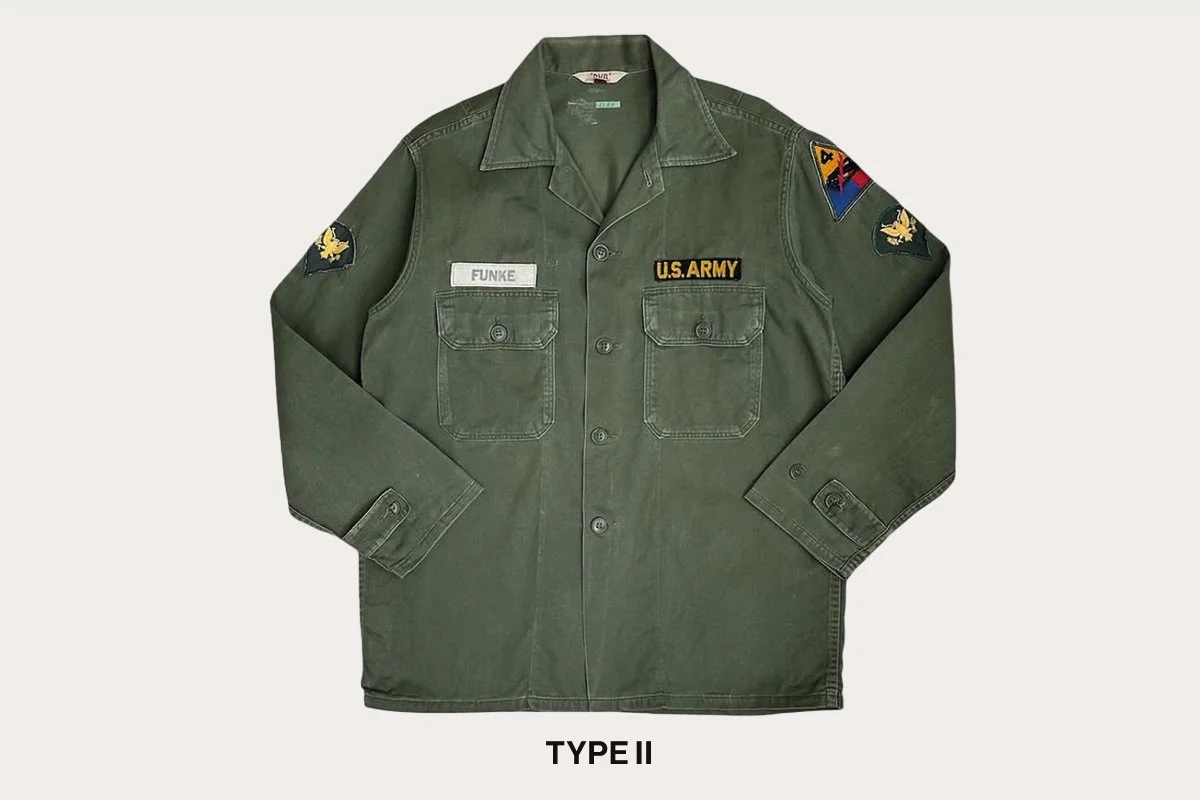
Fatigue Shirt Type II: 1963-1964
Type III: 1964-1989
Cotton Sateen: 1964-1975: The earlier version of Type III continued to use 100% cotton sateen, retaining the basic characteristics of the original OG-107 uniform while incorporating new details. The biggest change came in late 1964. The chest-pocket flaps became pointed, and buttons were added to the sleeve cuffs. The fit also became more shirt-like and less jacket-like, while the sizing changed from alphabetical sizes to actual body measurements.
This is also the version that is particularly interesting today because the cotton fabric develops a distinctive appearance with wear. Repeated washing and use gradually soften the fabric and fade the olive colour, meaning that two shirts that started out looking almost identical can eventually develop quite different character. The Type III also became the style most closely associated with Vietnam-era imagery, which is probably why it is what most people picture when they think of the OG-107 fatigue shirt.
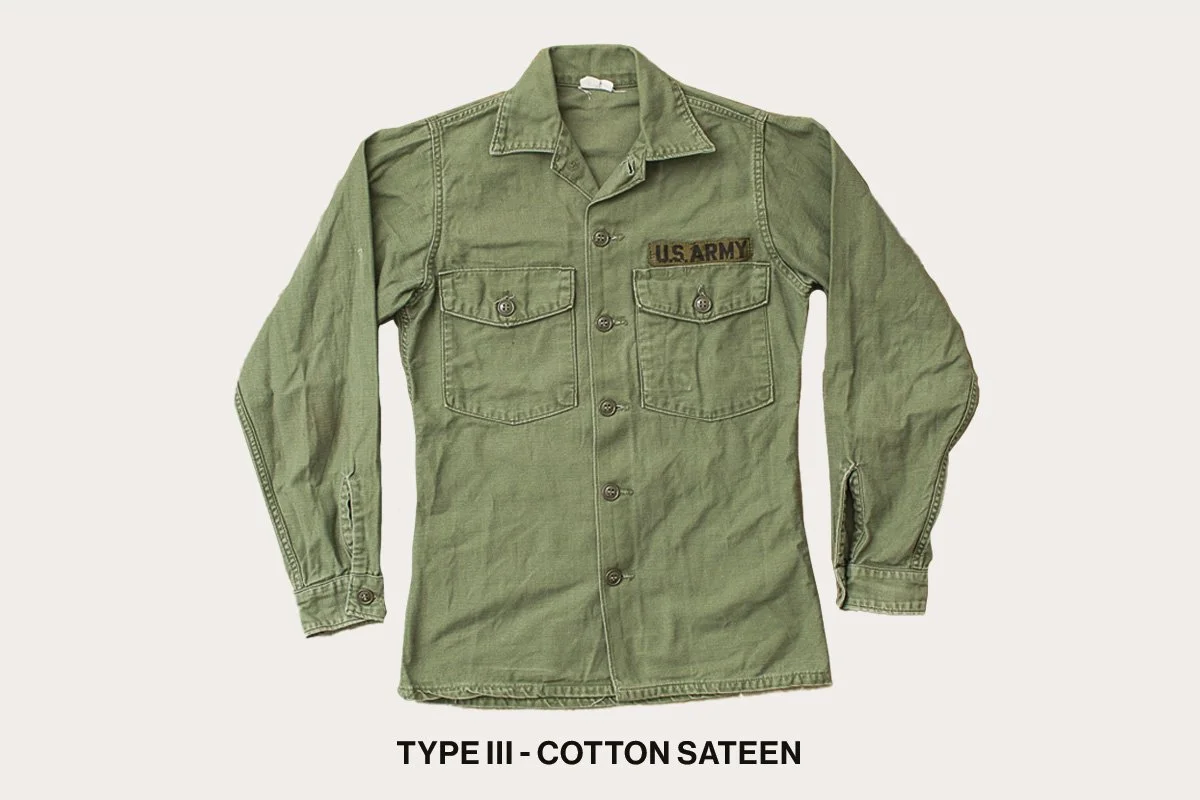
Fatigue Shirt Type III in Cotton Sateen
OG-507: 1975-1989: From around 1975 the Army began using a 50/50 cotton-polyester blend. This later version was known as OG-507 and remained in production until 1989, when the woodland BDU replaced it.
The OG-507 looked almost identical to the earlier cotton version, but the polyester blend made it easier to care for. These shirts were often called “Permanent Press” or “Durable Press” because they did not require the same extensive starching as the earlier cotton versions. The easiest way to identify one is by the yellow tag inside the shirt.
For someone looking for a vintage OG-107 today, this distinction is important. The OG-507 is much easier to find than an earlier 100% cotton Type III, but the fabric feels and ages differently because of the polyester content.
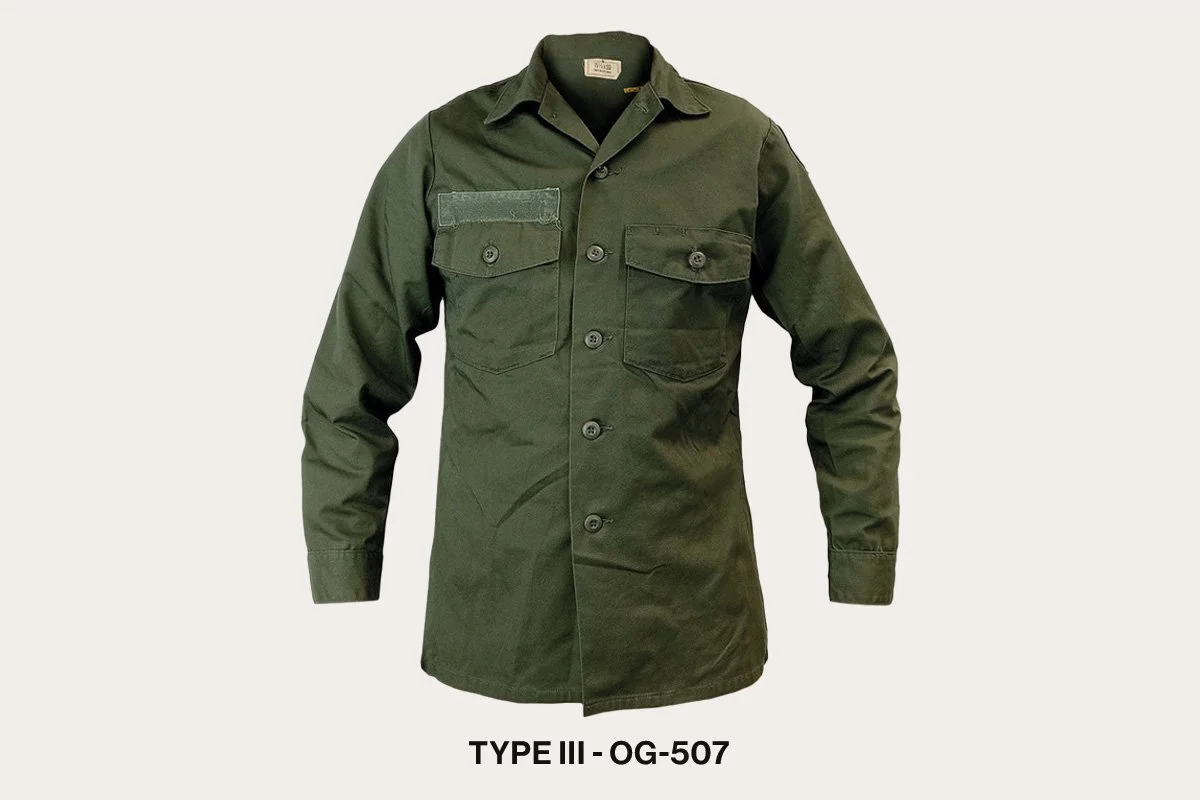
OG-507 version of the Type III Fatigue Shirt. The OG-507 version can be easily recognized by its yellow tag.
Air Force “Crew Blues”
There was also a rare Air Force version based on the Type II pattern, which became known as “Crew Blues.” Introduced around 1967, these dark blue two-piece fatigue uniforms were worn by Strategic Air Command missile combat crews, including crews responsible for Titan, Minuteman and Peacekeeper missile systems, as well as some Transient Alert crews.
The shirts followed the general Type II pattern but were made in dark Air Force blue rather than Olive Green 107. They were officially produced in different Air Force blue shades, including Shade 1577 and Shade 1549, and retained the blue-on-white name tapes used with Air Force uniforms of the period. A special “COMBAT CREW” badge was worn above the right name tape, while Strategic Air Command, squadron and missile-related insignia were placed on the sleeves and chest pockets.
Missile crews also commonly wore the uniform with an ascot scarf, with the colour varying between squadrons. The Crew Blues were a highly specialised uniform and remained associated with Air Force missile crews for decades.
The Air Force “Crew Blues” are interesting because they show how the basic fatigue-shirt design was adapted for a completely different service and purpose.
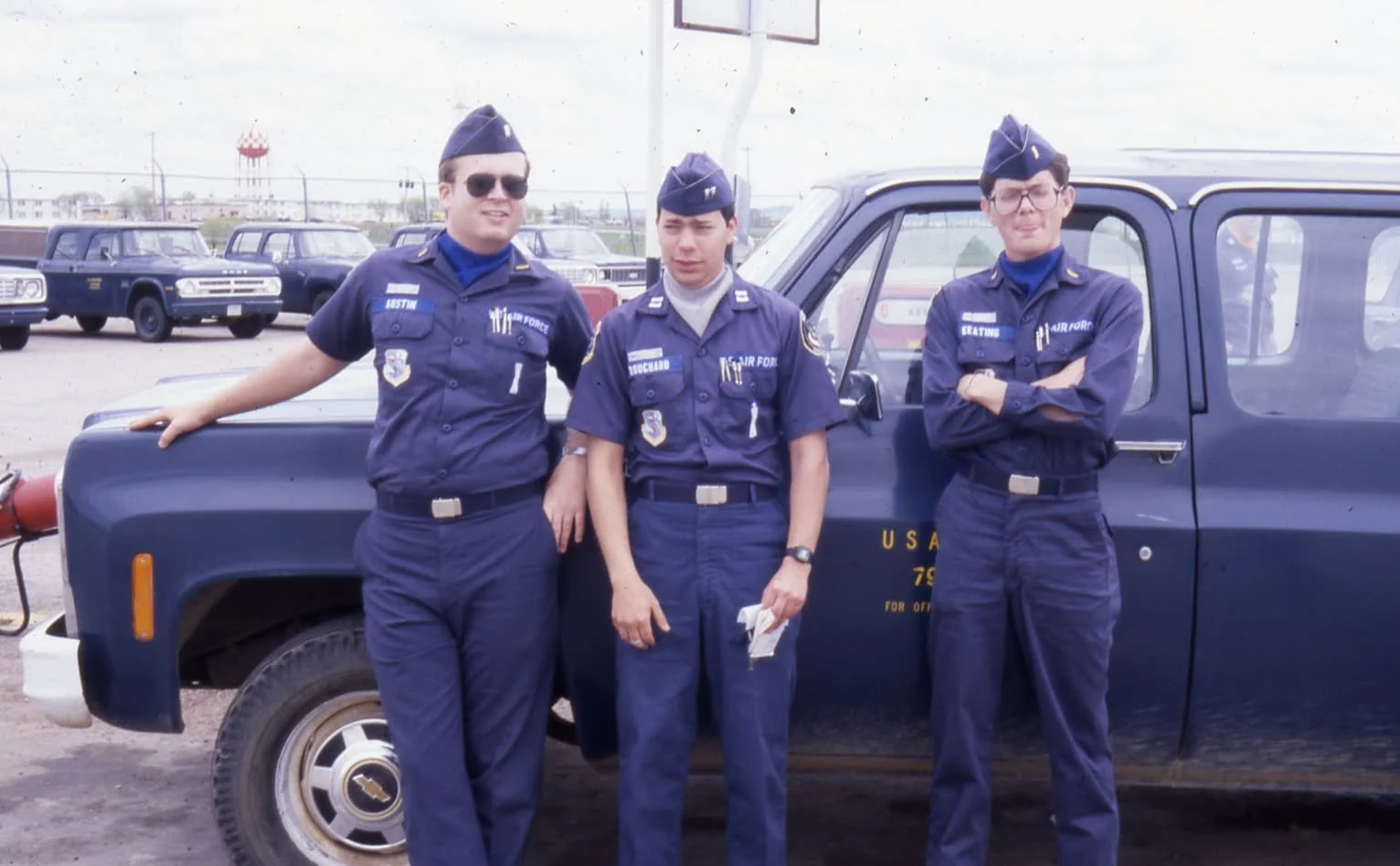
Air Force “Crew Blues” / photo from Minuteman Missile National Historic Site
The OG-107 Combat Uniform is strongly associated with the Vietnam War, but its role during the conflict was more complicated than the photographs might suggest. The cotton-sateen utility uniform was still standard issue when American involvement in Vietnam expanded. But the tropical environment created a need for lighter combat clothing, which led to the introduction of the Tropical Combat Uniform, better known as jungle fatigues or the jungle jacket. Designed specifically for tropical combat, the Tropical Combat Uniform was made from lighter cotton poplin and later ripstop fabrics. It had a distinct bush-jacket-style design, with slanted chest pockets and lower pockets. As it became more widely available, it was increasingly worn by combat units in Vietnam, while OG-107 utilities continued to be used in rear areas and by troops outside Southeast Asia. This distinction is worth remembering because the OG-107 shirt is sometimes confused with the jungle fatigue shirt, even though the two are completely different designs. The OG-107 was a general-purpose utility shirt, while the jungle jacket was developed specifically for combat in tropical environments, with a lighter construction and a different pocket configuration.
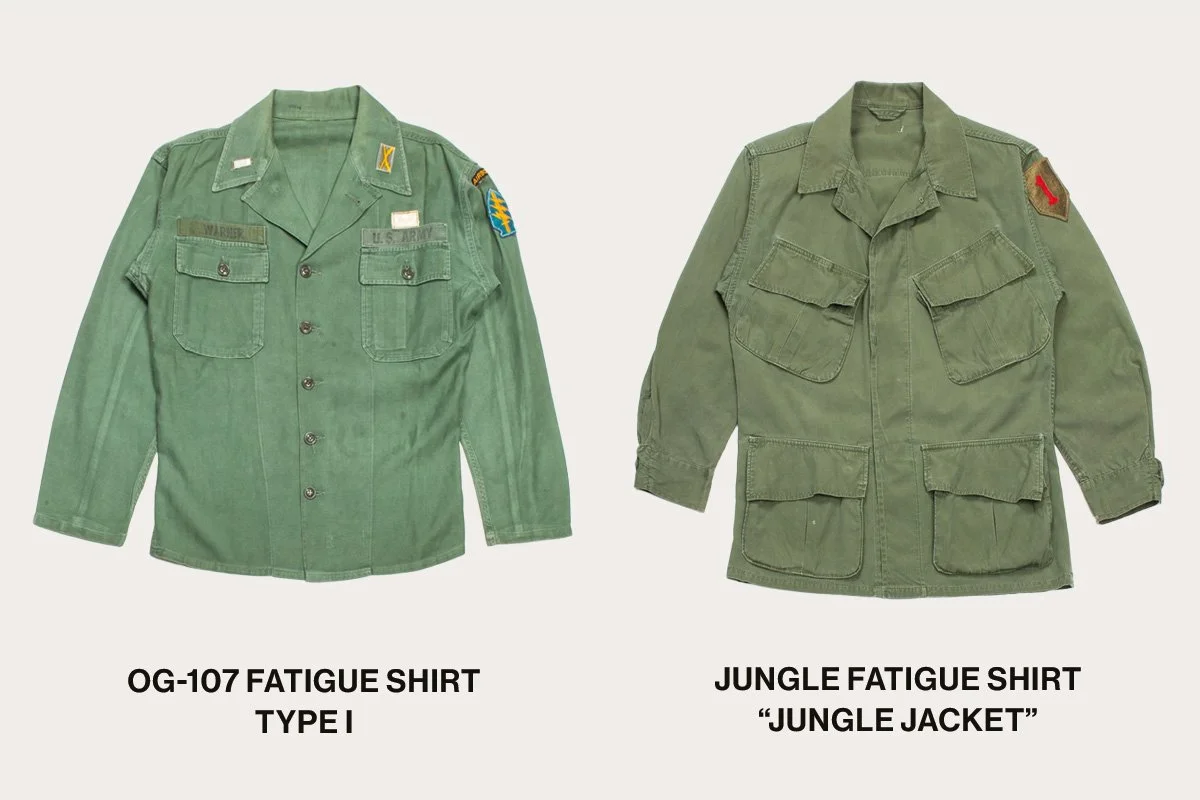
OG-107 Fatigue Shirt vs. Jungle Jacket. The difference is easy to spot side by side.
Like the fatigue pants, the shirt eventually escaped the military context.
The enormous quantities produced for the U.S. military meant that OG-107 clothing became readily available through surplus channels. And military surplus has always had a strange afterlife in civilian clothing.
The OG-107 shirt was particularly easy to adopt because it didn't look excessively military once the insignia were removed. It was essentially a simple olive overshirt with two useful pockets. This practical side is important to understanding why military surplus became so popular outside the military. Climbers, hikers and other outdoor enthusiasts valued the durability and simplicity of surplus military clothing, while later generations of designers and menswear enthusiasts became interested in the garments for their construction and history.
During the Vietnam era, that simplicity acquired another meaning. Veterans and anti-war protesters sometimes wore military clothing at demonstrations, turning the uniform into a symbol of opposition to the war and the establishment. So, similar to fatigue pants, the shirt also became associated not only with the military itself but also with people rejecting what the uniform represented.
It also became part of the wider American tradition of wearing military surplus for practical purposes. A shirt originally designed to be inexpensive, durable and easy to produce happened to work very well as everyday clothing too.
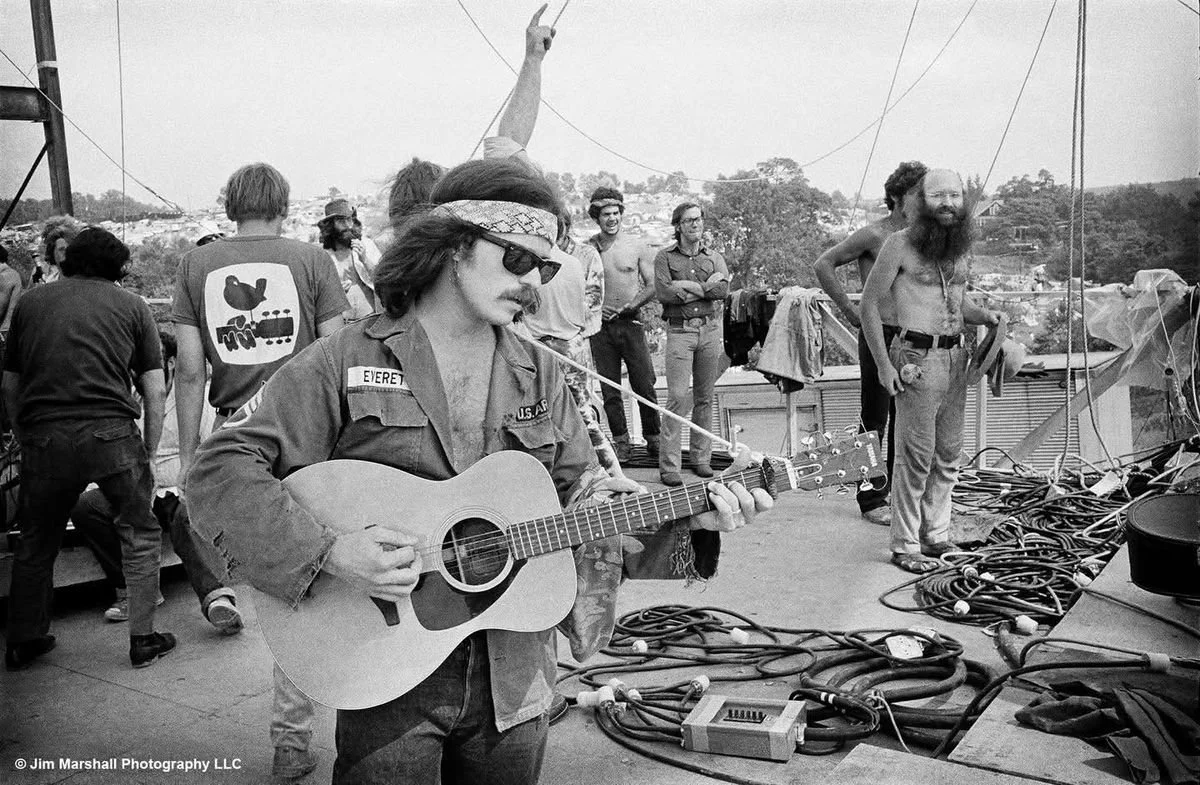
Joe McDonald at Woodstock in 1969 / photo by Jim Marshall
But then there was John Lennon, probably the most famous civilian wearer of the OG-107 shirt. He famously wore an OG-107 Type III shirt with an Imjin Scout patch and personalised details. The Imjin Scout badge was associated with soldiers of the U.S. Army's 2nd Infantry Division who completed specialised reconnaissance training and missions around the Korean DMZ.
The garment became particularly significant because Lennon wore it in a completely different context from the one for which it had been created. So, a U.S. Army utility shirt became part of the visual language of one of the most famous musicians and anti-war figures of the era. That shirt, with its specific combination of badges, has since become so iconic that both The Real McCoy's and Buzz Rickson's have made reproductions based on Lennon's version. It is a good example of how military clothing can acquire a second life through the people who wear it.
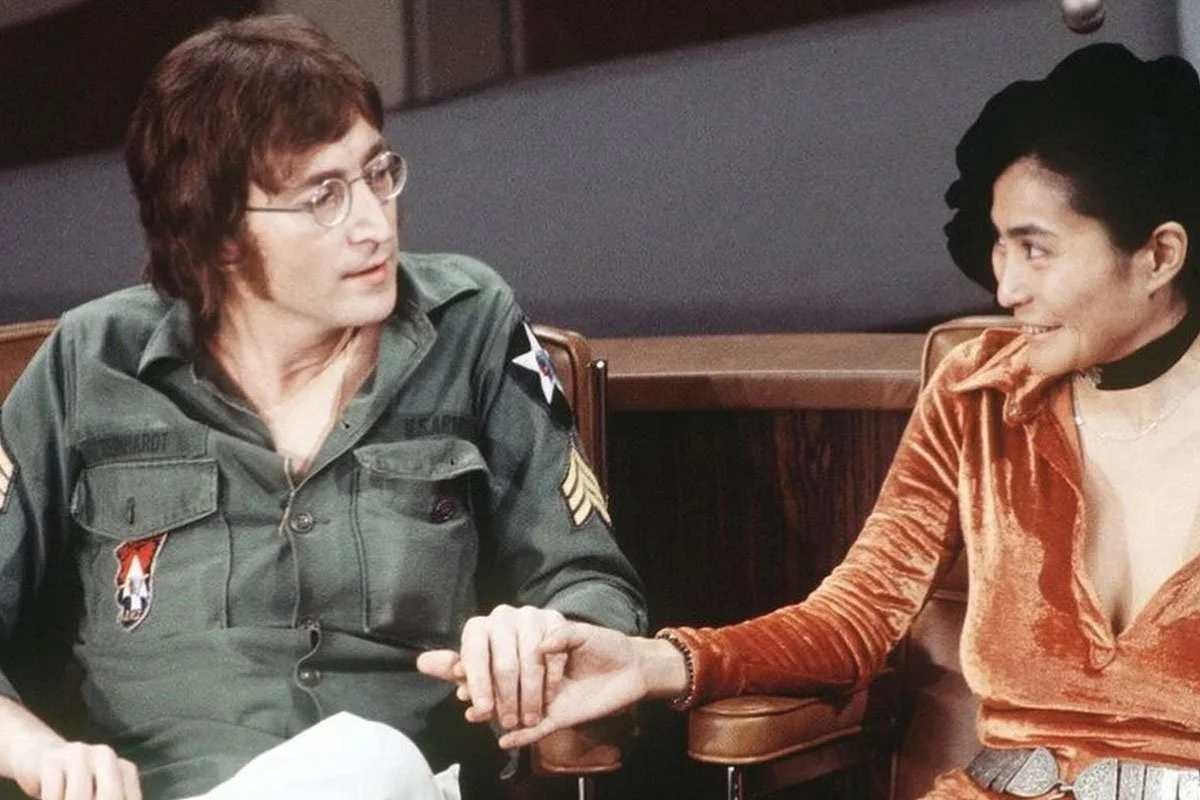
John Lennon in his Fatigue Shirt (Type III)
And for the same reasons the shirt was quickly adopted by civilians, it is still being worn and reproduced today. Its simple design, no unnecessary hardware, no exaggerated details and no obvious attempt to make it fashionable are part of what makes it so enduring. Cotton sateen also fades nicely and develops its own character with more wear and washes, so it is one of those garments that tends to improve with age.
There are plenty of OG-107 shirts available today, from vintage originals to modern reproductions, but the quality can vary considerably. If you want to add one to your wardrobe, I’ve put together a guide to the best-quality fatigue shirts you can buy today.
related articles
The evolution of the OG-107 Fatigue Shirt, from its introduction as a U.S. Army utility uniform to its role during the Vietnam War and eventual transition from military surplus to a menswear classic.